
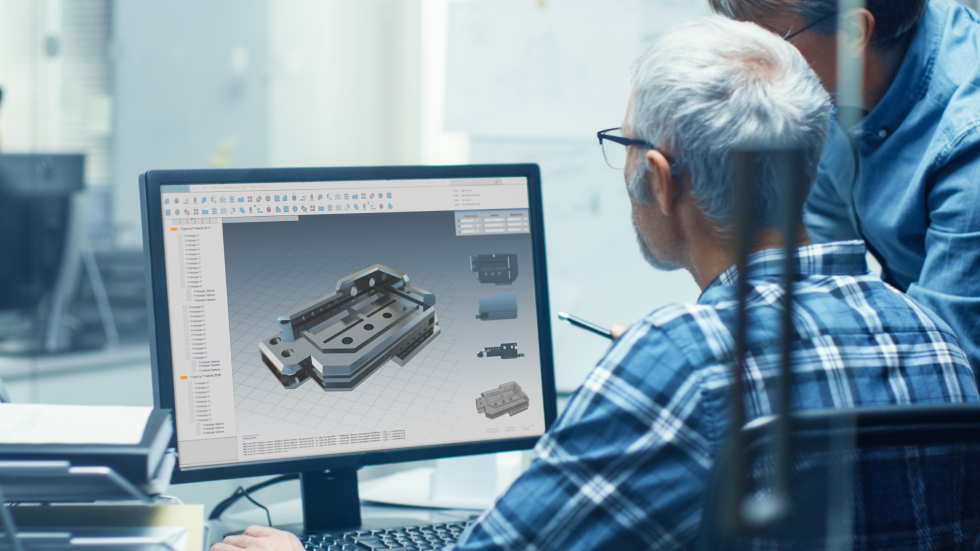
Achieving AS9100 compliance in aerospace machining projects often involves complex documentation practices, precise machining procedures, and typically involves considerable risk of human error. These traditional processes can create production bottlenecks and jeopardize quality control for these high-performance applications. Aerospace manufacturers must adhere to stringent AS9100 quality standards, where even minute discrepancies can lead to compliance issues and expensive delays or safety concerns.
Ultra Precision provides aerospace customers with a streamlined manufacturing process using a single data model. This approach delivers AS9100-certified components with exceptional accuracy for countless applications within the aerospace industry. Model-based manufacturing, or MBM, with an experienced machining company like Ultra Precision, addresses these challenges by substituting a digitized, model-driven process for manual documentation, ensuring exceptional accuracy, efficiency, and traceability from the earliest design phases through final inspection.
What is Model-Based Manufacturing?
Model-Based Manufacturing (MBM) is the process of using a single, data-rich 3D model to drive all production operations. This approach is built on the foundation of Model-Based Definition (MBD) and is certainly more than a recent trend, as it has become an increasingly sought-after approach for AS9100-certified aerospace machining companies.
According to Capvidia, MBD is the process of using a 3D CAD model that establishes and incorporates product manufacturing information as the definitive authority throughout the product lifecycle, creating a “single source of truth” for the entire process.
This process helps by putting the specs as design requirements right in front of the programmer. They can see everything centrally located in one source, rather than having to use the model file and a separate 2D drawing file for complete design definition. Typically, customers give a model-based manufacturer a 3D PDF to detail information that is not explicitly on the model.
This includes information such as:
- Geometric dimensioning and tolerancing (GD&T)
- Bill of materials (BOM)
- Surface finish
- Weld symbols
- Manufacturing or measurement process plan data
- Metadata and notes
- History of engineering change orders
- Legal, proprietary, export control notices
- And any other definitive digital data.
This model-based engineering approach is the new form of handling manufacturing data, which uses models instead of traditional documents for all manufacturing practices. Perhaps most importantly, MBD data is interoperable and CAD/CAM/CAE agnostic. As such, it is the basis of Model-Based Manufacturing and Model-Based Enterprise.
Current Challenges
Model-based manufacturing requires customers to apply all geometric dimensioning and tolerancing (GD&T) data directly to the 3D model. This creates a standardization challenge for the final inspection process. Currently, no universal format exists for how inspection software should present and interpret this embedded information.
How MBM Directly Supports AS9100 Compliance
Model-Based Manufacturing directly addresses AS9100’s stringent configuration management requirements by establishing the MBD model as the single, version-controlled master record. This creates a seamless digital thread that provides an unbroken, auditable history for every component from initial design through final production.
By eliminating the possibility of using an outdated drawing, this system inherently reduces the risk of non-conformance and production errors. There are even specific clauses within the AS9100 guidelines that are directly supported by the model-based manufacturing approach.
- AS9100 Clause 8.1: Operational Planning & Control → MBM provides version-controlled digital records that extensively improve planning and oversight.
- AS9100 Clause 8.5: Production & Service Provision → MDB automates the programming of coordinate measuring machines to ensure continuity and conformity during final inspection phases.
- AS9100 Clause 9.1: Monitoring & Measurement → Model-based manufacturing generates digital inspection reports to serve as objective evidence that all machining and inspection activities follow AS9100 guidelines.
The methodology also revolutionizes quality control by using embedded data to automatically program Coordinate Measuring Machines (CMM) for inspection. This automated process removes human error and guarantees that every part is verified directly against the authoritative master model.
As a result, MBM generates the exact digital reports and objective evidence needed to demonstrate full compliance during rigorous AS9100 audits and can significantly reduce associated costs. While it is still developing as a standardized approach, automated inspection is one of the greatest attributes that MBD or MBM can bring to the table.
The Impact of MBM on Production Operations
The most significant impact of MBM is the shift from traditional 2D drawings to a single, data-rich 3D model as the sole source of manufacturing information. This change eliminates the ambiguity and interpretation errors that frequently cause production delays and mistakes.
MBD helps catch errors earlier in the product lifecycle, which is always less expensive than finding them on the shop floor. As a direct result, aerospace machining operations see a dramatic reduction in costly scrap, rework, and recalls. This is a crucial benefit when working with expensive aerospace-grade materials.
This model-based approach significantly accelerates the entire production workflow from start to finish and offers considerable relief to customers struggling with long lead times. Critical processes are streamlined because CAM and CMM software can pull manufacturing data directly from the model and reduce manual programming time. This increase in operational efficiency results in expedited turnaround times and allows the facility to take on more complex, high-precision work with greater confidence.
From Model-Based Manufacturing to a Model-Based Enterprise
Implementing Model-Based Manufacturing is the first step toward a larger strategic goal: becoming a Model-Based Enterprise (MBE). This represents a full digital transformation where the 3D model drives not just production, but the entire business.
This evolution is part of a larger industrial movement:
- Model-Based Enterprise (MBE): Expands the model-based strategy across the entire business, using the 3D model as the single source of truth for departments like sales, supply chain, and quoting.
- Digital Manufacturing: A broad term for using any digital technology to improve manufacturing. MBM is an advanced and highly integrated form of it.
- Smart Manufacturing: Adds a layer of connectivity and data analysis to digital processes. MBM provides the perfect digital “master plan” that these systems use to make intelligent decisions.
- Industry 4.0: The high-level concept of the fourth industrial revolution. MBM is a practical implementation of its principles that turns the vision of a “digital twin” into a factory-floor reality.
Making the Transition to Model-Based Manufacturing
Model-Based Manufacturing centralizes all production information into one 3D model. This method improves accuracy and streamlines operations from design to final inspection.
At Ultra Precision, we utilize this model-based system to produce complex components. Our process ensures every part conforms precisely to the master design file.
Click below for a quote and to learn more about our manufacturing capabilities.